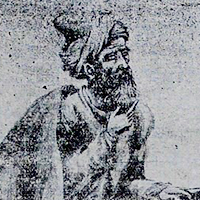
Profile of Shaikh Fariduddin Attar
Farridudin the Chemist, a great illuminate and author and an organiser of the Sufis. He died over a century before the birth of Chaucer, in whose works references to Attar's Sufism are to be found. More than a hundred years after his death the foundation of the Order of the Garter showed such striking parallels with his initiatory Order that this can hardly be a coincidence.
Fariduddin was born near Omar Khayyam's beloved Nishapur and his father bequeathed him a pharmacy, which is one reason given for his surname and Sufi style Attar—the Chemist. Of his life a great many stories are told—some of them involving miracles, other containing his teachings. He wrote a hundred and fourteen works for the Sufis, the most important of which is undoubtedly the Parliament of the Birds, a forerunner of Pilgrim 's Progress. Still a classic of Sufism and Persian literature alike, the Parliament describes the Sufi experiences and is itself based in plan on earlier Sufi quest themes. It unfolds meanings which become perceptible with the Sufi awakening of the mind.
The story of Attar's conversion, which the Sufis use to illustrate the need for balance between material and metaphysical things, is given by Daulat-Shah, in the classic Memoirs of the Poets. It is not accepted as literal reporting, but allegorical. Attar was in his shop one day, among his numerous and varied merchandise, when a wandering Sufi appeared at the door, gazing in with his eyes filled with tears. Fariduddin at once told the man to be gone,. "It i not difficult for me", replied the traveller,.. "I have nothing to carry; nothing but this cloak. But you, you with your costly drugs? You would do well to consider your own arrangements for going on your way." This impact so profoundly impressed Attar that he renounced his shop and his work and withdrew into a Sufi settlement for a period of religious retreat under the aegis of the master Sheikh Ruknuddin. While a great deal is made of his aesthetic practices, he himself maintained the importance of the body, even saying:
"The body is not different from the soul, for it is a part of it; and both are a part of the Whole".
His teachings are not only embodied in his poetical works, but also in the traditional rituals which are believed by Sufis to be a part of them. Reference to this will be made later; it is the sphere where Sufic poetry, teaching and 'work' (amal) coincide. Attar was one of the Sufis most deeply versed in the biographies of the earlier historical Sufis and his only prose work, Memoirs of the Friends (or Recital of the Saints), is devoted to a collection of these lives. It was on his wanderings to Mecca and elsewhere after he quit the Sufi circle of Ruknuddin that he decided to make the collection.
In his old age Attar was visited by the young Jalaluddin Rumi and he presented him with one of his books. Rumi made more public the initiator) aspects of the Sufi lore which Attar pursued. Later, he was to refer to him as his own soul:
"Attar traversed the seven cities of love and we have reached only a single street".
Attar died, as he had lived, teaching. His last action was deliberately calculated to make a man think for himself. When the barbarians under Jenghiz Khan invaded Persia in 1220, Attar was seized, by now a man of one hundred and ten years of age. One Mongol said:
"Do not kill this old man; I will give a thousand pieces of silver as a ransom for him".
Attar told his captor to hold out, for he would get a better price from someone else. A little later another man offered only a quanity of straw for him. Attar said:
"Sell me for the straw for that is all that I am worth" and he was slain by the infuriated Mongol.
Attar's romantic and quest writings have been shown by Garcin de Trassy to resemble the Roman e la Rose and belong, of course, the direct Sufi stream of romance teaching which antedates its appearance in Europe. A romance piece which gave rise to later material on a similar Sufi theme was written by Majriti the Cordoban.
It is probable that the romance material reached Western Europe through Spain and southern France, rather than through Syria, where the Sufi compositions of this genre were well established. Western scholars who believe that the Grail legend entered Europe through the Crusaders base this assumption only on the Syrian sources. Syria and Andulausia. however, were strongly linked. The transformation of 'Q' into G' (Qarael Muqaddas [Holy Recital] for Garuwl Mugaddas) is Hispano-Moorish. Not Sy rian. De Tassy notes that the Roman de la Rose has analogies with two Sufi streams of literature—that of the Birds and the Flowers and above all with the Parliament of the Birds of Altar.